
1. Industry Overview: Low-Power Smartband Trade Dynamics Between China & Sri Lanka
As Sri Lanka accelerates its national digital healthcare initiatives and experiences exponential growth in consumer wellness awareness across commercial hubs like Colombo, Kandy, Galle, and Jaffna, the demand for enterprise-grade, energy-efficient wearable technology has reached an unprecedented high. Importers, consumer electronics distributors, healthcare providers, and corporate wellness organizers in South Asia are increasingly looking toward original equipment manufacturers (OEMs) and original design manufacturers (ODMs) in Shenzhen and Guangdong, China—the global epicenter of wearable hardware innovation.
The overarching challenge in tropical emerging markets such as Sri Lanka lies not merely in raw metric tracking, but in power management and environmental resiliency. Intermittent power infrastructure, warm ambient temperatures, high relative humidity (averaging 70% to 90% year-round in coastal regions), and intensive daily usage require smartbands that operate continuously without frequent recharging cycles. Chinese low-power consumption smartband exporters have emerged as vital partners for Sri Lankan businesses by delivering state-of-the-art wearables engineered with micro-ampere sleep states, ultra-low energy (ULE) microcontrollers, and duty-cycled photoplethysmography (PPG) optical sensor arrays.
2. Micro-Architecture & Power Optimization Algorithms Explained
Achieving white-paper level energy conservation requires a holistic synthesis of semiconductor architecture, firmware optimization, and mechanical design. Leading Chinese exporters utilize advanced Bluetooth Low Energy (BLE 5.3 / 5.4) system-on-chips (SoCs) from industry pioneers like Dialog Semiconductor, Nordic Semiconductor, and Realtek. These SoCs integrate hardware-level power state management that allows the wearable to operate at micro-ampere current levels when sensors are idle.
| Architecture Feature | Standard Wearable Hardware | China Ultra-Low Power Exporter Standard | Sri Lanka Operational Advantage |
|---|---|---|---|
| BLE Connectivity | Bluetooth 4.2 / 5.0 (High Peak RX/TX) | BLE 5.3/5.4 with Fast Connection Interval | 60% reduction in RF power consumption during data sync with iOS/Android |
| PPG Sensor Power | Continuous Constant-On LED (12-15mA) | Dynamic Duty-Cycled Pulse (0.8mA average) | 24/7 continuous heart rate & SpO2 tracking without battery drain |
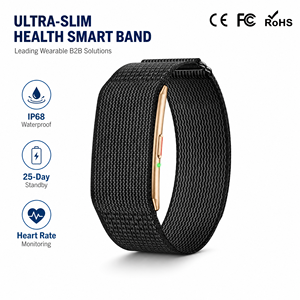
| Screen Architecture | Unoptimized TFT LCD Screens | Screenless Woven Bands or Low-Power OLED/AMOLED | Prevents screen backlight thermal buildup in high tropical temperatures |
| Battery Chemistry | Standard Li-ion (150 Lifecycle) | Pure Cobalt High-Density Li-Po (500+ Lifecycle) | Sustained battery capacity despite frequent Sri Lanka heat exposure |
| Ingress Protection | IP67 Light Splash Resistant | IP68 / 5ATM Sealed Injection Molding | Impervious to heavy monsoon rainfall and high coastal humidity |
Furthermore, algorithmic power dynamic allocation (APDA) dynamically adjusts optical sensor sampling frequency based on real-time accelerometer motion vector analysis. When an individual is resting or sleeping, the PPG sensor sampling rate seamlessly scales down from 25Hz to 1Hz, conserving vital milliwatts while maintaining clinical telemetry fidelity for continuous blood oxygenation (SpO2), heart rate variability (HRV), and continuous blood pressure trend monitoring.