
WATCHMARK® Smartwatch & Health Technology Blog — Insights & Articles
Featured Medical-Grade & OEM Wearable Solutions
Direct-from-Factory B2B Wholesale & Custom ODM Hardware Solutions
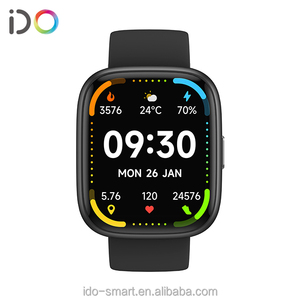
1. Executive Summary: The Evolution of Sleep Apnea Monitoring in Smart Wearables
Obstructive Sleep Apnea (OSA) has emerged as one of the most underdiagnosed global chronic health conditions, affecting an estimated 936 million adults worldwide between the ages of 30 and 69. Traditionally, diagnosing OSA required overnight polysomnography (PSG) in accredited sleep laboratories—a costly, non-invasive yet uncomfortable process characterized by multi-channel sensors measuring electroencephalography (EEG), electrooculography (EOG), electromyography (EMG), and pulse oximetry. However, the shift toward proactive personal health tracking and remote patient monitoring (RPM) has accelerated the demand for continuous, consumer-grade and medical-grade sleep apnea detection smartwatches and screenless health wristbands.
For electronics procurement directors, medical device distributors, and consumer brand OEMs, identifying high-precision manufacturing partners has become a strategic priority. Modern sleep apnea detection smartwatches integrate advanced multi-wavelength reflective Photoplethysmography (PPG) optical sensors, red and infrared light-emitting diodes (LEDs), 3-axis accelerometer motion capture, and Heart Rate Variability (HRV) micro-arousal algorithms. By tracking oxygen desaturation index (ODI) drops alongside sleep stage transitions (REM, Light, Deep), modern wearables deliver clinical-grade screening capabilities directly from the user's wrist.
2. Technical Sensor Architecture: How Modern Smartwatches Detect Hypopnea & Apnea
To evaluate a smartwatch factory's technical capabilities, B2B buyers must understand the sensor optics and firmware algorithms that differentiate low-cost novelty smartbands from genuine health-monitoring wearables. The detection of sleep-disordered breathing relies on a triad of biomechanical signal acquisition vectors:
A. Reflective Photoplethysmography (PPG) and SpO2 Pulse Oximetry
Pulse oximetry measures peripheral capillary oxygen saturation ($SpO_2$) by emitting light at two distinct wavelengths—Red light (~660 nm) and Infrared light (~940 nm)—through the vascular tissue of the wrist. Oxygenated hemoglobin ($HbO_2$) absorbs more infrared light, whereas deoxygenated hemoglobin ($Hb$) absorbs more red light. By continuously measuring photodiode light intensity ratios ($R = \frac{AC_{660}/DC_{660}}{AC_{940}/DC_{940}}$), the device calculates real-time oxygen saturation levels. Advanced factories integrate high-SNR (Signal-to-Noise Ratio) optical sensors from vendors like Texas Instruments, Maxim Integrated, or Nordic Semiconductor paired with low-power microcontrollers.
B. Heart Rate Variability (HRV) and Sympathetic Activation
When an obstructive apnea event occurs, air passages are physically blocked, causing asphyxia, hypercapnia, and negative intrathoracic pressure. This triggers a surge in sympathetic nervous system activity, causing a rapid pulse rate spike (tachycardia) immediately following the cessation of the apnea event. By capturing beat-to-beat (RR interval) micro-variations using continuous ECG or high-frequency PPG, the internal software algorithm identifies sympathetic micro-arousals even when the user remains unconscious.
C. Actigraphy & Respiratory Inductance Emulation
Restlessness and sudden bodily movements detected via 6-axis or 3-axis motion sensors correlate with the end of an apnea period as the brain briefly wakes the body to restore muscle tone in the upper airway. By synthesizing motion data, pulse rate surges, and SpO2 dips, the device's diagnostic firmware computes an estimated Apnea-Hypopnea Index (AHI).
| Biometric Metric | Basic Fitness Tracker | Medical-Grade OEM Smartwatch | Clinical Polysomnography (PSG) |
|---|---|---|---|
| SpO2 Sampling Frequency | Spot-check or 15-min intervals | Continuous (1Hz - 100Hz high-rate) | Continuous 256Hz channel |
| Optical LED Configuration | Single Green LED (HR only) | Multi-array Red + IR + Green LEDs | Finger-clip dual wavelength sensor |
| AHI Correlation Accuracy | Uncalibrated / General Estimate | > 88% correlation with PSG (R² = 0.89) | 100% Gold Standard Benchmark |
| Battery Optimization | Standard MCU (High drain during sleep) | Dual-Core MCU with dedicated DSP/NPU | External power supply |
3. Top 10 Sleep Apnea Detection Smartwatch Manufacturers & Suppliers (2026 Benchmark)
Below is the industry benchmark list of the top 10 global factories, OEM manufacturers, and turnkey enterprise suppliers specializing in sleep-monitoring wearables, high-precision SpO2 smartbands, and health tech hardware.
4. B2B Sourcing Trends & Technological Roadmap (2026–2030)
As the wearable technology sector matures, enterprise buyers must align their product development roadmaps with upcoming industry trends. Sourcing directors should prioritize factory capabilities aligned with the following four technological vectors:
1. Transition from Display Smartwatches to Screenless Minimalist Health Bands
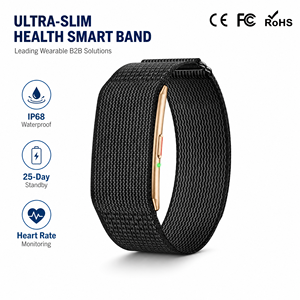
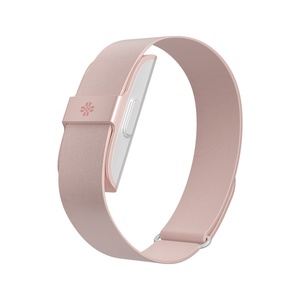
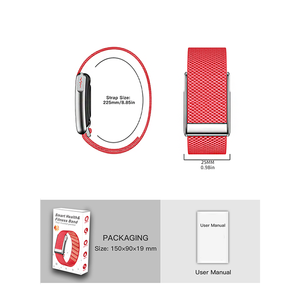
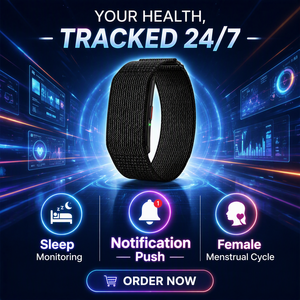
While traditional smartwatches require daily charging due to power-hungry OLED/AMOLED screens, the corporate wellness and clinical trial sectors are rapidly shifting toward screenless smart bracelets (such as the ultra-thin 7.5mm woven strap models). Eliminating the display reduces power consumption by up to 80%, allowing continuous 100Hz SpO2 sampling over 25 to 45 days on a single charge. This dramatically improves user compliance during long-term sleep studies.
2. On-Device AI Micro-Arousal Neural Networks
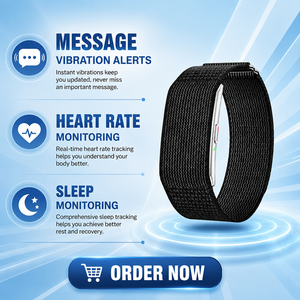
Legacy wearables rely on post-hoc cloud processing to calculate sleep scores. Next-generation OEM smartwatches integrate low-power TinyML (Machine Learning on MCU) inference engines directly into the hardware chip (e.g., Apollo4 or Nordic nRF5340). This enables real-time, on-wrist detection of airway blockages and immediate haptic vibration alerts to prompt positional changes (e.g., nudging the user to roll from back to side), actively mitigating obstructive events during sleep.
3. Medical Device Regulation (MDR) & FDA 510(k) Pre-Certification
Global regulatory bodies are tightening scrutiny on health claims made by wearable brands. Sourcing certified hardware platforms—such as products carrying European CE MDR compliance and UKCA certification—enables enterprise buyers to enter regulated healthcare and insurance reimbursement markets without undergoing lengthy 24-month clinical validation cycles from scratch.
4. Open SDKs and Telehealth API Integration
B2B buyers increasingly require custom mobile app SDKs (iOS/Android) and RESTful APIs to ingest raw PPG, SpO2, and acceleration data directly into centralized electronic health record (EHR) platforms or enterprise fleet management dashboards. Leading factories now supply white-label companion applications paired with secure AWS/Azure HIPAA-compliant cloud backends.
5. Procurement Guide: Key Evaluation Metrics for B2B Smartwatch Buying
When conducting factory audits or requesting RFQs (Request for Quotations) for sleep apnea smartwatches, procurement managers should evaluate suppliers against five core operational criteria:
Verify whether the optical module features multi-PD (photodiode) arrays and Fresnel lenses to reduce motion artifacts and accommodate varied skin tone melanin levels.
Ensure the manufacturing facility holds ISO 13485 (Medical Devices) and ISO 9001 certifications alongside automated optical inspection (AOI) SMT lines.
Sleep apnea devices require continuous 24/7 wearability. Demand minimum IP68 or 5ATM ingress protection ratings tested in ultrasonic pressure chambers.
6. Enterprise Manufacturing Capabilities & OEM/ODM Advantages
As a premier European health wearable manufacturer and global B2B supplier, our organization combines European quality control standards with optimized high-capacity manufacturing lines. We specialize in turning complex biometric monitoring requirements into market-ready retail products.
Headquartered in London and Germany with dedicated service facilities in Poland, all wearables undergo stringent compliance verification, carrying certified CE and UKCA marks for seamless European retail distribution.
From customized woven straps, ultrathin 7.5mm screenless form factors, and laser-engraved corporate branding to specialized firmware logic and custom packaging design.
In-house R&D teams continually refine continuous SpO2 algorithms, blood pressure monitoring formulas, and HRV sleep stage scoring against clinical data.
 UKCA Certified
 CE Certified