
WATCHMARK® Smartwatch & Health Technology Blog — Insights & Articles
An ECG Health Smartwatch combines a wrist sensor, electrodes, software, and a mobile app. It records the heart’s electrical activity through skin contact. When a user touches the watch’s bezel, the circuit captures a single-lead ECG tracing. The result may show rhythm patterns, such as regular sinus rhythm or possible atrial fibrillation. It does not replace a hospital ECG.
The technology has gained credibility through large-scale research. The Apple Heart Study, published in the New England Journal of Medicine, enrolled 419,297 participants. Among participants receiving irregular-rhythm notifications, the ECG patch showed atrial fibrillation in 84% of cases. That figure is useful, but it is not a guarantee. A smartwatch can miss brief episodes, especially when the wrist moves or contact is poor. Sweat, tattoos, loose straps, and cold fingers can also weaken the signal.
The U.S. Food and Drug Administration distinguishes wellness functions from medical-device claims. This distinction matters. A consumer ECG smartwatch may support screening and personal monitoring, but qualified clinicians must interpret concerning results. The American Heart Association also emphasizes that wearable data needs clinical context, symptoms, medical history, and confirmatory testing. In this guide, we will examine how the electrodes detect voltage changes, how algorithms classify rhythms, and where the technology remains limited. The screen may display a neat waveform. The human body is less neat. That uncomfortable gap deserves careful attention.
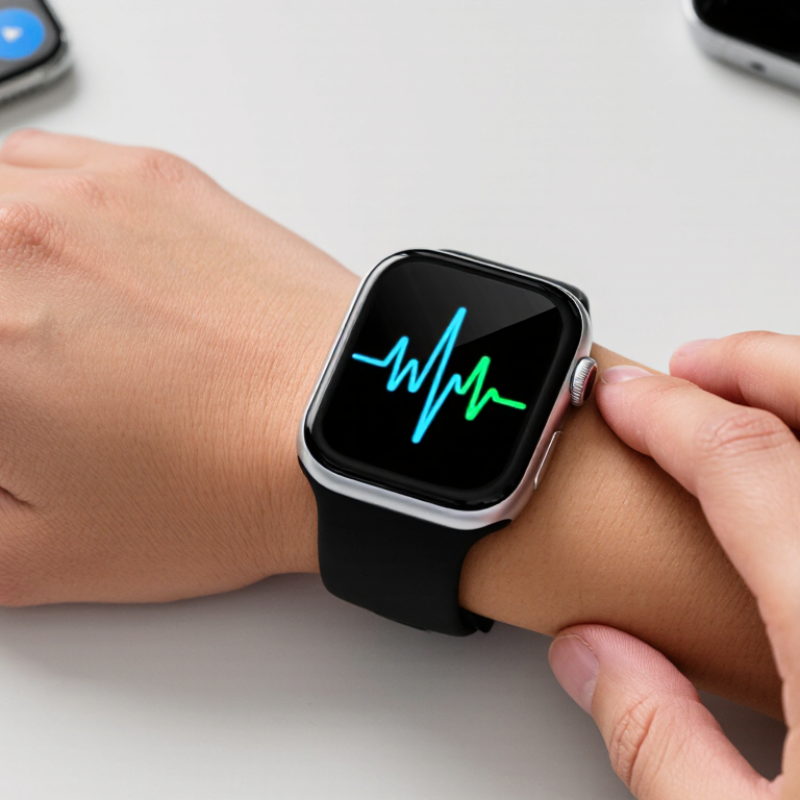
What an ECG Health Smartwatch Is
What Is an ECG Health Smartwatch and How Does It Work?
What an ECG Health Smartwatch Is
An ECG health smartwatch is a wearable device that records the heart’s electrical activity. Small sensors touch the skin, often through the watch case and a side button. When you complete a reading, the watch detects electrical signals across your wrist and finger. It then creates a simple electrocardiogram, usually showing heart rhythm over several seconds.
This reading may identify patterns linked with an irregular rhythm, such as possible atrial fibrillation. However, it does not provide a complete medical examination. Movement, loose contact, sweat, or dry skin can affect the result. A normal reading also cannot guarantee that every heart problem is absent. That limitation matters. The screen can look precise, yet the information remains limited.
Tips: Sit quietly, rest your arm, and follow the device instructions. Keep the sensors clean and maintain steady finger contact. Record unusual symptoms, including chest discomfort, faintness, or sudden breathlessness. Share readings with a qualified healthcare professional instead of changing medication yourself. Some results may be unclear. Repeat the reading only when you feel safe, and seek urgent medical help for severe or sudden symptoms.
What Is an ECG Health Smartwatch and How Does It Work?
| Data Dimension | Typical Data or Specification | How the ECG Smartwatch Works | Practical Meaning |
|---|---|---|---|
| Type of Heart Signal | Electrical activity of the heart, measured in millivolts (mV) | Electrodes on the watch case and the user's finger or opposite hand detect small voltage differences produced by cardiac activity. | An ECG records electrical signals, while optical sensors measure blood-volume changes rather than electrical activity. |
| Lead Configuration | Usually a single-lead recording | The watch and the user's contact point form one electrical pathway across the body, commonly producing a tracing similar to Lead I. | A single-lead ECG is useful for rhythm screening but provides less anatomical information than a clinical 12-lead ECG. |
| Recording Duration | Commonly about 30 seconds per measurement | The user remains still and maintains skin contact while the device records a short waveform. | A short recording may capture an intermittent rhythm, but it may miss symptoms that do not occur during the measurement. |
| Main Waveform Components | P wave, QRS complex, and T wave | The device displays the changing voltage pattern associated with atrial depolarization, ventricular depolarization, and ventricular repolarization. | These waveform components help describe heart rhythm and timing, although interpretation should be performed by a qualified professional when medically important. |
| Heart-Rate Calculation | Beats per minute (bpm), calculated from the interval between R waves | Software identifies repeating QRS complexes and estimates the time between successive ventricular beats. | The displayed rate is an estimate based on the recorded segment and can be affected by movement, noise, or missed beats. |
| Typical Resting Adult Reference | Approximately 60–100 bpm for many healthy adults | The watch reports the rate during the measurement; the result is not automatically a diagnosis of health or disease. | Fitness, age, medication, stress, illness, and individual physiology can place a person's normal rate outside this general range. |
| Rhythm Screening | Irregular-rhythm and atrial-fibrillation screening may be available | Algorithms examine beat-to-beat timing and waveform characteristics for patterns associated with an irregular rhythm. | A notification is a screening result, not confirmation. It should be reviewed by a healthcare professional, especially when symptoms are present. |
| Signal Quality Factors | Stable skin contact, clean electrodes, and minimal movement | The device checks electrical contact and may reject or label recordings affected by motion, loose contact, sweat, or electrical interference. | Poor contact can create noise or an inconclusive result even when the heart rhythm is normal. |
| Measurement Limitations | Not equivalent to a clinical 12-lead ECG | The smartwatch samples electrical activity from a limited pathway and generally does not measure all standard chest and limb leads. | It cannot reliably detect every cardiac condition, including some structural problems or abnormalities outside the recorded lead. |
| Data Storage and Sharing | Digital waveform, heart rate, date, and time | The recording can typically be saved in an associated health application and exported or shared as a report, depending on device software. | Stored readings can help users discuss recurring symptoms and measurements with a healthcare professional. |
| When to Seek Urgent Care | Chest pain, severe shortness of breath, fainting, or severe palpitations | The ECG function may provide useful information, but it should not delay emergency assessment when serious symptoms occur. | Urgent symptoms require prompt medical attention regardless of whether the smartwatch produces a normal, abnormal, or inconclusive result. |
Important: An ECG health smartwatch is a screening and monitoring tool, not a replacement for professional medical evaluation or a clinical 12-lead ECG.
FAQS
It measures the heart’s electrical activity through skin contact. The recording usually shows one electrical view over several seconds.
Sensors on the back and side detect tiny voltage differences. The watch converts these signals into a waveform with P, QRS, and T sections.
It may identify patterns linked with possible atrial fibrillation. An alert is not a diagnosis. Clinical confirmation remains necessary.
Movement, sweat, dry skin, or loose contact can distort the signal. A broken line may reflect your hand moving during measurement.
Sit quietly and rest your arm on a table. Keep the sensors clean and touch the contact steadily. Small details matter.
No. A normal result cannot exclude every heart problem. The watch provides limited information, even when the screen looks precise.
Most smartwatches record a single-lead signal. A clinical 12-lead ECG examines electrical activity from several directions. The views are not equivalent.
Save the tracing with its time, symptoms, and recent activity. Share it with a qualified healthcare professional. Do not change medication independently.
Seek urgent care for severe chest discomfort, fainting, or sudden breathlessness. Do not rely on the watch during serious symptoms. Safety matters more.
Conclusion
An ECG Health Smartwatch is a wearable device designed to record and present information about the heart’s electrical activity. By using sensors that detect tiny electrical signals through contact with the skin, it can create a simplified electrocardiogram, often when the user touches designated areas on the watch. The device then processes the signal, filters out some interference, and displays the recording or a basic rhythm interpretation through its interface or connected application.
An ECG Health Smartwatch may help identify patterns associated with an unusually fast, slow, or irregular heartbeat, including possible signs that deserve professional evaluation. However, its readings can be affected by movement, poor skin contact, electrical noise, or incorrect use. It is generally intended for wellness tracking and supporting conversations with healthcare professionals, not for replacing clinical tests or diagnosing conditions independently. Users should seek medical attention for serious or persistent symptoms, regardless of what the smartwatch reports.